
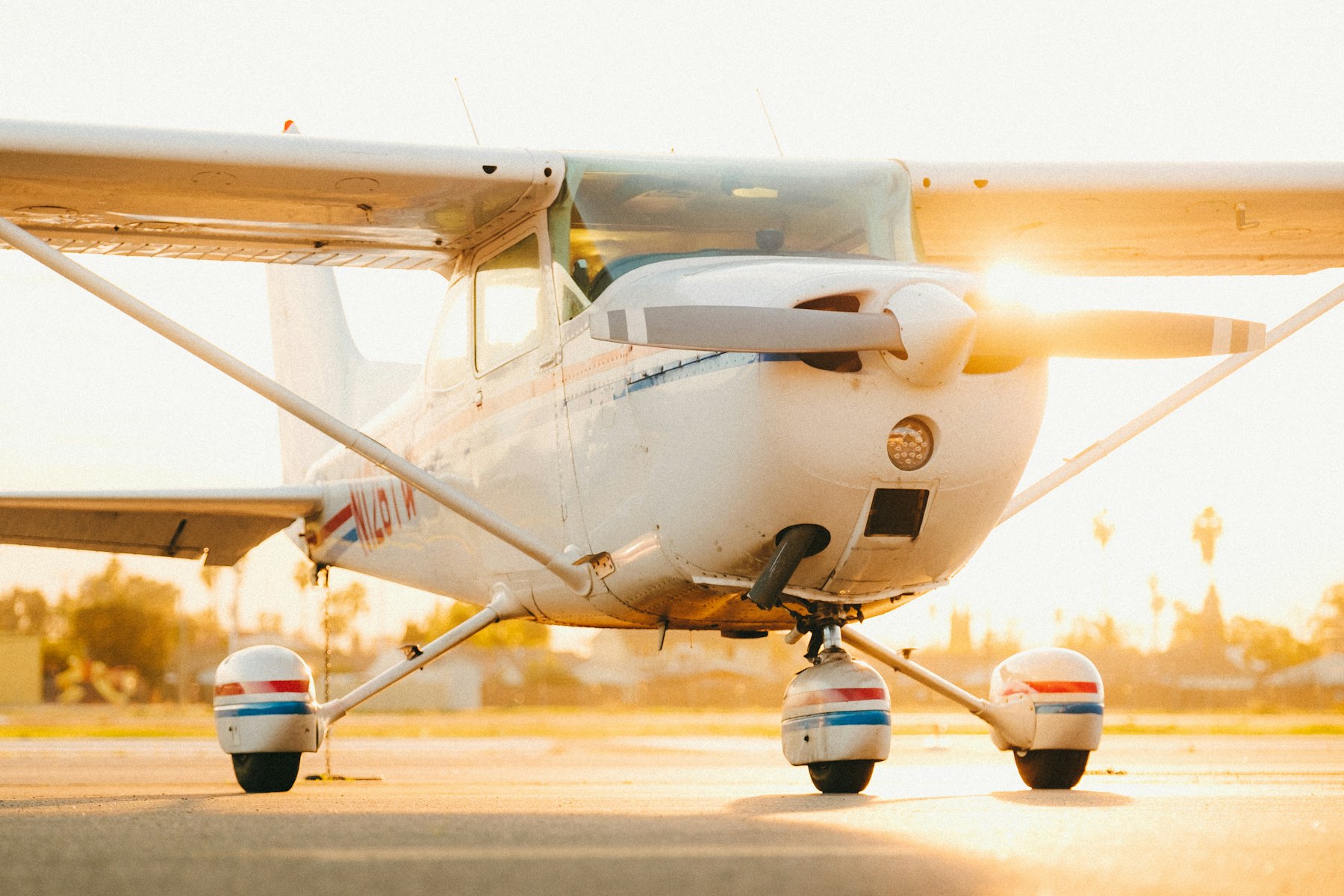
Type Primary Trainer
Cessna 172 Skyhawk
Odds are strong your first logbook entry happens in a Cessna 172. More pilots have learned in the Skyhawk than in any other airplane, full stop; the type has been in production since the 1950s and tens of thousands of them fill training ramps worldwide. There's a reason instructors trust it: the 172 forgives the mistakes students are supposed to make.
The high wing gives you a clear view of the ground for pattern work, the airplane telegraphs a stall before it happens, and it lands slow enough that a flare timed badly usually embarrasses nobody. None of that makes it a toy. A modern 172 carries a Garmin G1000 glass panel, the same design language you'll meet again in jets.
- Seats
- 4
- Engine
- Lycoming, 180 hp
- Cruise
- About 120 knots
- Range
- Around 600 nm
- Panel
- G1000 in modern models
- Role
- Private through CFI
Representative figures for the type. Model year and configuration move the numbers.
What Flying One Teaches You
Stick-and-rudder fundamentals live here: coordinated turns, slips, crosswind corrections, energy management on final. The 172's honesty is the feature. When your airspeed sags or your rudder work gets lazy, the airplane says so immediately and recoverably, which is exactly the feedback loop a new pilot needs.
Schools rent Skyhawks at roughly $150 to $200 per hour wet, making it the affordability benchmark for the whole training fleet. Parts exist everywhere, every mechanic knows the type, and dispatch reliability keeps your three-lessons-a-week momentum alive.
Student Questions, Answered
Is the 172 too basic to prepare me for jets?
Backwards, actually. Airlines teach jets to people who already fly precisely, and precision is learned where mistakes are cheap. Instructors who've sent hundreds of students up the ladder will tell you the crisp 172 pilots make the smooth 737 pilots.
Steam gauges or glass panel: does it matter which 172 I rent?
Learn attitude flying either way; the airplane doesn't care which display style reports your errors. If your school runs both, doing early lessons on round dials and instrument work on the G1000 gives you range on checkride day and beyond.
Why do rental rates for the same 172 vary by $50 an hour?
Age, avionics, and the school's overhead. A 1970s airframe with basic radios legitimately rents cheaper than a new G1000 ship. Pay for the airplane that matches the lesson: cheap for maneuvers, glass for instrument training.
Where It Fits On Your Path
You'll likely fly the 172 from your discovery flight through your commercial maneuvers, then teach in it as a CFI. Thousands of airline pilots logged their first 500 hours in this exact type, and the pattern still works.
What It Costs and Why Everyone Rents One
Skyhawk economics explain its monopoly on training ramps. Wet rental rates at most schools run $150 to $200 an hour, parts exist in every maintenance shop in America, and insurance underwriters price it as the known quantity it is. For schools that math means uptime, and for students it means the airplane is actually available Tuesday at 4pm when your lesson block says so. Examiners have watched thousands of checkrides in 172s; there is no airplane in which your test day holds fewer surprises for anyone in the cockpit.
The type's long production run also built a used-market ladder worth knowing about. Partnerships and flying clubs keep older 172s working for $100-and-change an hour in some markets, which changes hour-building math after the commercial certificate. Students who buy a quarter-share of a mid-70s Skyhawk for the time-building years, then sell it at airline hiring, sometimes fly those hundreds of hours for close to the cost of fuel. Ask schools and clubs about partnership boards; the option hides in plain sight at most airports.
From the right seat, what the 172 teaches best is honesty about fundamentals. The airplane telegraphs every uncoordinated turn through the seat of your pants and every misjudged flare through the mains, feedback that fancier machines increasingly filter out, and instructors watch students transfer those calibrated hands to everything they fly afterward. Examiners see thousands of rides in the type and read applicants instantly against that baseline, which cuts both ways: sloppy habits have nowhere to hide, and precise flying registers immediately. When airline interviewers ask about your primary training, the Skyhawk needs no explanation anywhere in the world, and that universality is itself a kind of credential. Boring, ubiquitous, and quietly perfect at the job: there are worse descriptions of a training partner.
Related Aircraft
Train Toward This Flight Deck
Get matched with schools whose fleets and airline pipelines point at the seat you want.